
Introduction: The Cloud’s Quantum Leap
As we approach 2025, cloud computing stands on the precipice of its most transformative phase yet. What began as a simple shift from on-premise servers to remote data centers has evolved into the central nervous system of global digital transformation. The future of cloud computing in 2025 isn’t just about more storage or faster processing—it’s about a fundamental reimagining of how businesses operate, innovate, and compete in an increasingly digital-first world. This evolution represents a convergence of artificial intelligence, edge computing, sustainability imperatives, and unprecedented security challenges that will redefine the technological landscape across Gujarat, Valsad, and every digital-forward region worldwide.
The cloud of 2025 will be virtually unrecognizable from its predecessors. We’re moving beyond the basic “lift-and-shift” migrations to intelligent, autonomous systems that anticipate needs, optimize resources in real-time, and seamlessly integrate with emerging technologies. For businesses in industrial hubs like Vapi or financial centers like Mumbai, this means access to capabilities once reserved for tech giants, democratized through increasingly sophisticated cloud platforms. This article explores the seven key dimensions that will characterize this next-generation cloud ecosystem.
1. The Rise of AI-Integrated Cloud Architectures
From Cloud-Enabled AI to AI-Optimized Clouds
In 2025, the relationship between artificial intelligence and cloud computing will undergo a profound reversal. Instead of merely hosting AI applications, cloud platforms will become intrinsically intelligent, self-optimizing systems. Major providers like AWS, Azure, and Google Cloud are already embedding AI directly into their infrastructure layers, creating what industry analysts term “cognitive clouds.”
These AI-native platforms will feature predictive resource allocation that anticipates workload spikes before they occur—a crucial advantage for e-commerce businesses during Diwali sales or financial institutions during quarterly closings. We’ll see autonomous troubleshooting where the cloud identifies and resolves performance bottlenecks without human intervention, dramatically reducing downtime for critical operations. Perhaps most significantly, intelligent cost optimization will become standard, with systems continuously analyzing usage patterns to recommend and implement savings strategies, addressing one of the primary concerns for businesses across Gujarat’s manufacturing sector and beyond.
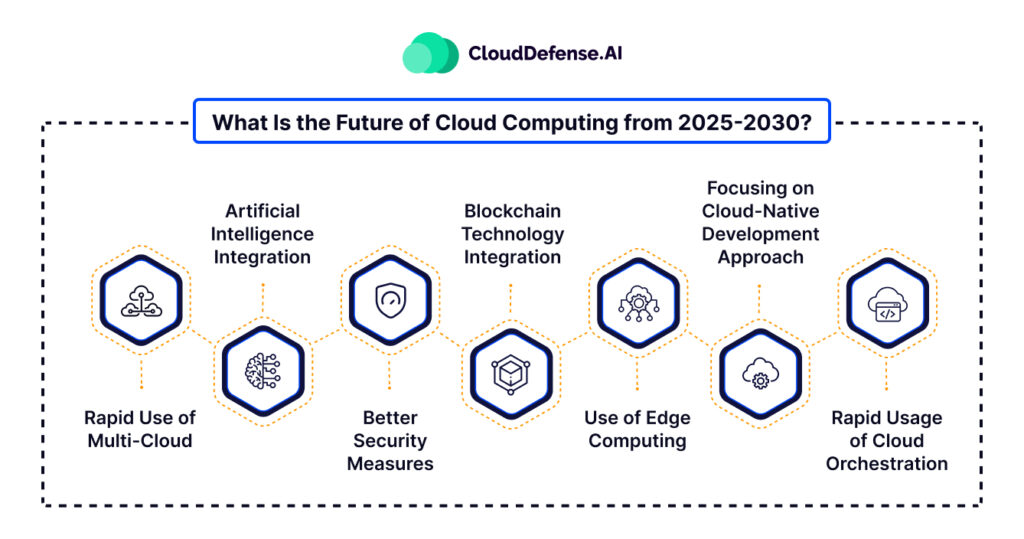
Democratization of Advanced AI Tools
The cloud will dramatically lower barriers to sophisticated AI implementation. Small and medium enterprises in Surat’s textile industry or Pune’s automotive sector will access the same machine learning tools as multinational corporations, thanks to cloud-based AI-as-a-Service offerings. We’ll see proliferation of:
- Pre-trained industry-specific AI models for retail, healthcare, and manufacturing
- No-code AI development platforms hosted entirely in the cloud
- Real-time data processing capabilities for immediate insights
- Automated machine learning operations (MLOps) for continuous model improvement
This democratization will fuel innovation across India’s diverse economic landscape, enabling businesses in Valsad’s chemical industry to implement predictive maintenance or Ahmedabad’s educational institutions to offer personalized learning—all powered by cloud-accessible AI that requires minimal technical expertise.
2. Quantum Computing Meets Cloud Infrastructure
The Hybrid Quantum-Classical Cloud Ecosystem
While practical, general-purpose quantum computing remains on the horizon, 2025 will see accelerated integration of quantum capabilities within traditional cloud frameworks. Leading cloud providers are developing hybrid solutions where specific computational tasks are routed to quantum processors while maintaining classical cloud infrastructure for everything else.
This hybrid approach will first transform fields with complex calculation requirements. Pharmaceutical companies could leverage quantum-cloud hybrids to dramatically accelerate drug discovery simulations. Logistics companies across India’s extensive distribution networks might optimize routing algorithms with quantum-inspired solutions. Financial institutions in Mumbai’s banking sector could employ quantum-enhanced risk assessment models for more accurate market predictions.
Early Adoption and Specialized Applications
Initial quantum cloud services will likely focus on:
- Optimization problems for supply chain and manufacturing
- Advanced cryptography and security applications
- Molecular modeling for materials science and chemistry
- Machine learning enhancement through quantum algorithms
For businesses in Gujarat’s industrial corridors, early experimentation with quantum-cloud capabilities could provide competitive advantages in process optimization and product development, even before quantum computing reaches mainstream adoption.
3. Edge Computing: The Distributed Cloud Revolution
The Convergence of Cloud and Edge
The most significant architectural shift in 2025 will be the seamless fusion of centralized cloud and distributed edge computing. Rather than competing paradigms, they’ll form a cohesive continuum where workloads automatically deploy to optimal locations based on latency requirements, data sensitivity, and cost considerations.
This distributed cloud model will prove particularly transformative for India’s diverse infrastructure landscape. Smart city initiatives across Gujarat could process traffic data locally at edge nodes while aggregating insights in regional cloud centers. Manufacturing facilities in Vapi’s industrial zone might run real-time quality control at the edge while sending production analytics to centralized cloud resources. The result is a flexible architecture that respects both the need for immediate local processing and comprehensive centralized analysis.

Industry-Specific Edge Implementations
In 2025, we’ll witness tailored edge-cloud solutions for:
- Industrial IoT in manufacturing, with real-time equipment monitoring
- Telemedicine platforms combining local device processing with cloud-based patient records
- Retail environments using edge analytics for customer behavior with cloud-based inventory management
- Agricultural technology processing field sensor data locally while utilizing cloud-based weather and market analytics
For regions like Valsad with strong industrial bases, this edge-cloud synergy enables digital transformation without complete infrastructure overhaul, allowing gradual, cost-effective implementation aligned with specific operational needs.
4. Sustainability: The Green Cloud Imperative
Carbon-Aware Cloud Architectures
As climate concerns intensify, 2025 will see sustainability become a primary design principle rather than a secondary consideration. Cloud providers will implement “carbon-aware computing” that dynamically shifts workloads to regions and times when renewable energy is most abundant. This isn’t merely about corporate responsibility—increasingly stringent regulations in markets like the European Union will make sustainable cloud practices a business necessity for companies with international operations, including many based in Gujarat’s export-oriented industries.
Transparency and Optimization Tools
The green cloud of 2025 will feature:
- Real-time carbon footprint dashboards for every workload and application
- Automated recommendations for reducing computational waste
- Increased utilization of energy-efficient specialized processors
- Water usage optimization in data center cooling systems
- Circular economy principles in hardware lifecycle management
For environmentally conscious businesses and those facing regulatory pressures, these capabilities will make sustainability measurable and manageable rather than aspirational, turning cloud computing from an energy consumption concern to an optimization opportunity.
5. Security in the 2025 Cloud Ecosystem
Zero-Trust Architectures as Standard
The perimeter-based security model will become obsolete in 2025’s cloud landscape, replaced by zero-trust architectures where every access request is verified, regardless of origin. This approach aligns perfectly with distributed workforces and multi-cloud environments, providing consistent security whether employees access systems from corporate offices in Delhi or remote locations in rural Gujarat.
AI-Enhanced Threat Intelligence and Autonomous Response
Security in 2025 will be characterized by:
- Predictive threat detection using AI to identify novel attack patterns
- Automated incident response that contains breaches within milliseconds
- Homomorphic encryption allowing data processing without decryption
- Unified security management across hybrid multi-cloud deployments
- Compliance automation for increasingly complex regulatory landscapes
For businesses handling sensitive data—from healthcare providers to financial services—these advancements will make robust security more accessible, protecting against increasingly sophisticated threats targeting cloud infrastructure.
6. Industry-Specific Cloud Solutions
Vertical Clouds: Tailored Digital Transformation
The one-size-fits-all cloud approach will give way to industry-optimized platforms in 2025. These vertical clouds will incorporate specialized tools, compliance frameworks, and data models specific to sectors like manufacturing, healthcare, education, and agriculture—all highly relevant to India’s diverse economy.
For Gujarat’s pharmaceutical industry, this might mean cloud platforms with built-in compliance tools for FDA and EMA regulations. For educational institutions across the state, specialized clouds could offer integrated learning management systems, research computing resources, and student data analytics. The key advantage is reduced complexity and faster implementation for industry-specific digital transformation.
Regional Cloud Hubs and Data Sovereignty
As data sovereignty concerns grow globally, 2025 will see increased development of regional cloud infrastructure. This trend aligns with India’s growing emphasis on digital sovereignty and could spur further development of cloud capabilities within Gujarat and neighboring states, reducing latency while ensuring compliance with national data regulations.
7. The Evolution of Cloud Economics and Skills
From Cost Management to Value Optimization
Cloud financial management will mature beyond simple cost tracking to comprehensive value optimization. In 2025, businesses will leverage AI-driven tools that quantify not just expenses but the business value generated by cloud investments—measuring how cloud capabilities improve customer satisfaction, accelerate time-to-market, or enhance operational resilience.
Democratized Cloud Expertise
The skills gap will begin to close through:
- AI-powered cloud management reducing manual administration
- Low-code/no-code platforms enabling business users to create cloud applications
- Specialized training programs tailored to regional industry needs
- Managed service providers offering localized expertise
For businesses in Valsad, Vapi, and across Gujarat, this means greater ability to leverage cloud capabilities without extensive in-house expertise, accelerating digital transformation across diverse sectors of the regional economy.
Conclusion: Preparing for the 2025 Cloud Landscape
The cloud computing landscape of 2025 represents both unprecedented opportunity and significant complexity. For businesses across Gujarat, Mumbai, Delhi, and beyond, success will depend on strategic preparation starting today. Organizations should begin by auditing their current cloud maturity, identifying skills gaps, and developing a roadmap that balances innovation with practical implementation.
The most successful adopters will be those who view cloud not as a technology project but as a continuous evolution of their digital capabilities. They’ll develop partnerships with providers who understand both global trends and local context—including the specific needs of businesses operating in Gujarat’s industrial zones or Delhi’s commercial hubs.
As we look toward 2025, cloud computing ceases to be a destination and becomes the journey itself—an evolving foundation upon which businesses will build their futures. The question is no longer whether to adopt cloud technology, but how strategically and effectively organizations can harness its next evolution to drive innovation, efficiency, and growth in an increasingly competitive digital economy.
For regions like Valsad with strong industrial bases, or commercial centers like Mumbai, the 2025 cloud represents a powerful equalizer—providing access to capabilities that can transform operations, create new value propositions, and build resilience against uncertainty. The future of cloud computing is not just technological; it’s fundamentally economic, social, and strategic. Those who understand and prepare for this multidimensional evolution will be positioned to thrive in the digital age that 2025 will fully bring into focus.
Expert Cloud Management in Valsad & Across India
Get professional cloud management services for your business in Valsad and throughout Gujarat. We provide expert monitoring, optimization, and security for AWS, Azure, and Google Cloud. Our solutions ensure your cloud infrastructure is cost-effective, scalable, and secure, helping businesses in Delhi, Mumbai, Hyderabad, Pune, and Noida achieve seamless digital transformation and enhanced operational efficiency.
Top Cloud Management Services in Ahmedabad, Gujarat
Our expert cloud management services in Ahmedabad and across Gujarat help businesses migrate, optimize, and secure their cloud environments. We offer tailored solutions for AWS, Azure, and Google Cloud, ensuring reliability, security, and cost savings. Partner with us for seamless cloud operations and support in Mumbai, Delhi, Hyderabad, Pune, and Noida.
Leading Cloud Management Company in Surat, Gujarat
As a leading cloud management provider in Surat and Gujarat, we deliver end-to-end solutions for businesses. Our services include cloud migration, security, cost optimization, and 24/7 support for AWS, Azure, and Google Cloud. We serve clients across India, including Delhi, Noida, Mumbai, Pune, and Hyderabad, ensuring peak performance and reliability.
Professional Cloud Services in Vadodara, Gujarat
We offer professional cloud management services in Vadodara and throughout Gujarat, specializing in AWS, Azure, and Google Cloud. Our solutions include infrastructure setup, security, performance monitoring, and cost management. We help businesses in Delhi, Noida, Mumbai, Pune, and Hyderabad streamline their cloud operations for maximum efficiency and growth.
Reliable Cloud Management in Rajkot, Gujarat
Ensure your cloud infrastructure runs smoothly with our reliable cloud management services in Rajkot and across Gujarat. We provide comprehensive support for AWS, Azure, and Google Cloud, including migration, security, and optimization. Our expertise extends to major Indian cities like Delhi, Noida, Mumbai, Pune, and Hyderabad, delivering scalable and secure solutions.
Secure Cloud Solutions in Gandhinagar, Gujarat
Protect and optimize your cloud environment with our secure cloud management services in Gandhinagar and Gujarat. We offer tailored solutions for AWS, Azure, and Google Cloud, focusing on security, compliance, and cost efficiency. Our services support businesses in Delhi, Noida, Mumbai, Pune, and Hyderabad, ensuring robust and resilient cloud operations.
Efficient Cloud Management in Bhavnagar, Gujarat
Streamline your cloud operations with our efficient cloud management services in Bhavnagar and across Gujarat. We specialize in AWS, Azure, and Google Cloud, providing migration, monitoring, security, and optimization. Our solutions help businesses in Delhi, Noida, Mumbai, Pune, and Hyderabad reduce costs and improve performance with expert cloud support.
Scalable Cloud Services in Jamnagar, Gujarat
Grow your business with our scalable cloud management services in Jamnagar and Gujarat. We offer end-to-end solutions for AWS, Azure, and Google Cloud, including setup, security, and performance tuning. Our services are designed for businesses in Delhi, Noida, Mumbai, Pune, and Hyderabad, ensuring flexible and future-ready cloud infrastructure.
Cost-Effective Cloud Management in Anand, Gujarat
Maximize your ROI with our cost-effective cloud management services in Anand and throughout Gujarat. We help businesses optimize spending on AWS, Azure, and Google Cloud while ensuring security and performance. Our expertise supports clients in Delhi, Noida, Mumbai, Pune, and Hyderabad, delivering tailored cloud solutions for sustainable growth.
24/7 Cloud Support in Junagadh, Gujarat
Get round-the-clock cloud management support in Junagadh and across Gujarat. We provide proactive monitoring, security, and optimization for AWS, Azure, and Google Cloud environments. Our dedicated team serves businesses in Delhi, Noida, Mumbai, Pune, and Hyderabad, ensuring minimal downtime and seamless cloud operations for your success.